Showing posts with label Photography. Show all posts

Wednesday, August 11, 2010

Mehendi

*posted by Kayd

I got mehendi done on my hands and arms today! (this is the original henna tattoo, but mehendi is a vegetable product and completely natural). Didun called a friend who highly recommended the artist who did my mehendi. I thought this would take like 20 minutes, maybe an hour max. Instead, I had to sit for a total of almost four hours while the fronts and backs of my arms and hands were done. The mehendi was placed on my arms and had to dry overnight before I scraped it off to reveal the final, polished design. Since I couldn't use my hands the first night, Didun had to feed me dinner and Arny had to take out my contacts so I could sleep. It was a long process but I keep getting complimented on the intricate detail of the work and how beautiful the designs are.

The saying goes: the more beautiful your mehendi is, the more your mother-in-law loves you, and the darker your palms get, the more your husband loves you. As you can see, my mehendi is gorgeous and my palms got really dark. Looks like Abhrajeet and his mom Kakoli love me a lot!


Tuesday, August 10, 2010

Hometown Antics

*posted by Jeet

Baroda (now known as Vadodara) is my hometown, the city where I was born. I've always loved Baroda - it's small for an Indian city, and has a much different feel than anywhere else I've been to in India. Quite frankly, things are pretty normal around these parts, but that doesn't mean Baroda doesn't have some awesome things to see.

Our first day here we visited Eme Mandir, which is a temple complex run by the local military school. Terrorism is a very real threat for everyday Indians, particularly in Western India, and the military presence in Baroda was very obvious. Regardless, my Didun told me that I used to love going to the Eme Mandir and playing there as a child. Katie, Arny and I checked it out, and it was a very peaceful place indeed - exactly what we needed at this point in the trip when we were utterly exhausted.The mandir complex itself was basically a small park with statues from all point of Indian-Hindu history, and the mandir had structural elements which represented five different religions in India: Hinduism, Islam, Jainism, Buddhism, and Christianity.

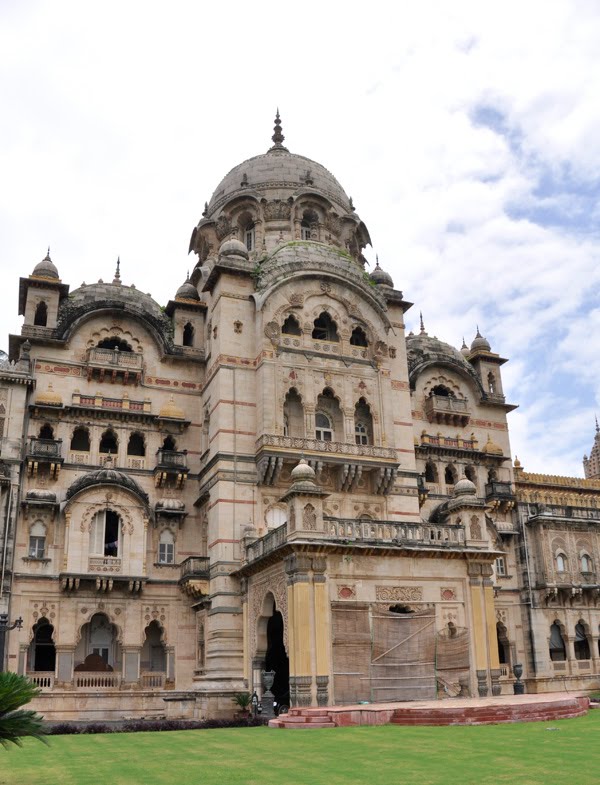
Our second day in Baroda was also pretty eventful. We checked out an old palace museum of Baroda which had artwork and statues from all over the world. It was small but sweet. After that we went and toured the Laxmi Vilas Palace, the epic dwelling of the old royal family of Baroda. The tour was complete with MP3 guides that were in English, just for us.

Finally we went to my favorite spot in Baroda: the zoo. I can still remember this zoo from my baby days - Didun tells me that I used to refuse to go to school unless she took me to see the birds in the morning. And for good reason - the bird collection at the Baroda zoo is massive, and there are many other animals at the zoo from all over India and the world. Clearly this is where my love for nature started, and it was awesome to be able to share the zoo experience with Katie and Arny.

Didun


Friends and relatives welcome with joy a loved one,
Returning from abroad after a long absence.
In exactly the same way will the fruit of right action,
Welcome the doer as she travels from one life to the next.

- The Dhammapada


Saturday, August 7, 2010

Akshardham: Government Sponsored Religion

*posted by Jeet

“…any attempt to bring all humanity to one method of thinking in spiritual things has been a failure and always will be a failure.” – Swami Vivekananda


Today we visited what was arguably the strangest religious institution I have ever been inside: Akshardham. The project was orchestrated by the BAPS (Bochasanwasi Shri Akshar Purushottam Swaminarayan Sanstha) movement, a collective of Hindus who donate a certain portion of their income to the movement in order to preserve its cultural heritage. Akshardham is a massive mandir, one of the largest in the world, and was completed in 2004 after an incredible effort put out by thousands of Indian craftsmen, artisans, and laborers. The architectural work is absolutely insane – every square inch of the mandir deserves praise and attention. Thousands of images of gods, sages, and animals are etched into the massive walls and domes of Akshardham. In addition, the sprawling mandir grounds are host to beautiful gardens, filled with fountains and various sculptural tributes to the history of India.

However, despite all the material beauty of Akshardham, I couldn’t help but feel like something was off – this place seemed to lack…well…soul. In the central and most ornate portion of the mandir stood a massive golden statue of a man who I could not recognize, despite my fairly decent knowledge of Hindu mythology and religion. Furthermore, after our self guided tour of the mandir we were given an animatronic history of this mysterious golden man, who we soon learned was the esteemed Swami Narayan, the man who this entire temple was a tribute to. No bullshit with the animatronics either, it was like the Pirates of the Caribbean ride at Disneyland, except with more subtle religious brainwashing. After the animatronic history lessons we were lucky enough to have a short boat ride (yes, boat ride, what the hell!?) through Vedic India and learned more about the greatness of ancient India. Despite the weird Disney feel of things up till this point, I was still pretty excited about the whole experience – after all I do love India and I do love Hinduism…so what was the big deal, right?

Anyways, following these history lessons came the most bizarre portion of the mandir visit: a 50 minute movie narrating the life of Swami Narayan which emphasized his values and divinity. Even weirder was the constant reassurance that Swami Narayan’s immaculate teachings had been passed down “through an unbroken lineage of spiritual masters!” The last time I checked there is no central Hindu “Pope” - hundreds of thousands of spiritual guides and teachers have existed throughout Indian history. At this point this shit just didn’t feel right – it was like the entire Akshardham experience was trying to create an entirely new Hindu godhead for the next millennium of Indians, an immaculate example for all to follow (Praise Jesus!). It seemed that there was some sort of hidden agenda in this towering new place of worship.

Overall, the entire experience was devoted to teaching the visitor about this Swami Narayan character. Everything elevated him to the highest level, and we were repeatedly told that his values can guide the world to a better tomorrow. Frankly, I agreed with every single value that was being purported, but it didn’t change the fact that Akshardham was trying to turn a man into an all-knowing godhead – something which doesn’t really sit well with most of the religious traditions of India.

My biggest concern about Akshardham is the fact that, although it technically preaches what I would consider universal values (non-violence, devotion, spirituality), it does so in an overbearing manner which threatens to alienate millions of Indians of all religions, both within the country and abroad. I can only hope this alienation has no physical backlash - the Akshardham in the state of Gujurat has already been a victim of terrorist attacks by extremist Muslims, attacks which became highly exploited by the BJP party of India, a Hindu nationalist party that has caused quite a stir in Indian government in recent decades.

Also, one final thing to note, before I end this massive post: none of my grandparents, including my 94 year old, all-knowing history buff Dadu, had too much to say about Swami Narayan besides the fact that he was a popular spiritual teacher among certain groups of Hindus. Interesting, right?

Regardless, I bought a few books about the godhead's teachings - hopefully the true essence of Swami Narayan is easier to swallow than the in-your-face religious fervor we endured during our trek to Akshardham...

“Believe nothing until you find it out for yourself; that is what Raja-Yoga teaches us. Truth requires no prop to make it stand.” – Swami Vivekananda

Friday, August 6, 2010

The Land of Bhang

*posted by Jeet


Mathura - birthplace of Krishna and one of the holiest cities in India. Ever since I first began planning this trip to India, Mathura was on the list of destinations. The city has intrigued both Indians and foreigners for thousands of years and is ancient in its practices and way of life.

In general I had three overarching goals for our short excursion to Mathura. First, I wanted to bathe in the Yamuna River and see the infamous riverside of Mathura, where the temple ghats go on for many kilometers. The Yamuna is another of India's great holy rivers and bathing in it is said to free oneself from the anguishes of death. My dad had told me that there were also giant tortoises, which sounded pretty awesome too, considering my lifelong love for giant reptiles.

My second goal for the trip was to smoke out with a sadhu. That's right, I wanted to smoke charas with an Indian ascetic/wise man. Charas is high quality, hand made hashish made from the resin of the cannabis plant (in India, the cannabis you find is straight indica, in case my fellow connoisseurs were wondering). Cannabis has been used for spiritual, recreational, industrial, and medicinal purposes in India for thousands of years, and many sects of sadhus utilize different forms of the plant during meditation and spiritual contemplation.

Which brings me to what my third major goal for Mathura was: I wanted to find some bhang. Bhang is basically the leaves and flowers of the cannabis plant mashed together into a paste and is used extensively in drinks during religious ceremonies and festivals in India, in particular the festival of colors, Holi. It is without a doubt the most natural form of cannabis ingestion in India (charas and ganja are both smoked). The god of destruction himself, Shiva, is said to be quite fond of bhang, so much so that one of his titles is The Lord of Bhang. Legit, legit, legit.

Both charas and bhang are available legally throughout India at special government authorized shops. Prior to India's recent adoption of some of the absurd cannabis prohibition laws of the West, all three forms of cannabis were easily obtained throughout the country without legal consequence or harassment. It's amazing how thousands of years of cultural tradition were abandoned to appease the international community, especially since alcohol and tobacco run rampant throughout modern India. Unfortunately, the increased regulation of the plant has only led to more corruption within India's law enforcement - obviously demand and usage of cannabis remains about the same. Luckily, bhang still seems to be a pretty normal and acceptable thing across India - nearly every single person we mentioned it to had something good to say about their own experiences with bhang. Free it up America - it's a first amendment right, and that's no joke.


So back to our Mathura journey.

Mathura is only a short drive from Vrindavan, where we had stayed overnight in the ISKCON mandir complex. After a delicious vegetarian meal at ISKCON's restaurant (one of the central goals of the ISKCON movement is to spread high quality and tasty vegetarian food to all) we checked out and were on our way to Mathura in order to find ourselves some ancient wisdom. Or so we thought.

Once we got into the outskirts of the city, we realized that we really had no idea where the Yamuna River was. My cousins even suggested that we had seen all there was to see in Mathura - there was no river, no sadhus, no bhang. Just a couple of dirty streets, one mandir, and some cows. I was told there was no holy city here - no birthplace of Krishna. But I was adamant - I knew the mythology of this city, and I hadn't traveled across the world for nothing. So, we asked somebody which way the river was. He said we'd have to drive about 12 kilometers and then he'd personally guide us down to the river/tortoises. Bullshit. I said we'll drive/guide ourselves. Remember, EVERYONE in India is a hustler - if you want to do something right, you have to do it yourself.

Of course, after driving the 12 kilometers to another part of the city, we asked another person where the river was. He said we had to drive 12 kilometers back (to where we originally were) and then walk about 4 kilometers down to the banks of the Yamuna. God dammit. So we turned around and went back.

Finally we got back and I was all set to go, along with Arny and Katie. But wait, my cousins didn't seem too keen on making the mini-pilgrimage through the dirty, crowded, and tiny streets of Mathura - where the car wouldn't be able to take them.

Good thing I didn't care, and neither did Arny or Katie.

In fact, Katie was the one who led the way as we started walking through the city. My brother and I followed excitedly, while my cousins got in a rickshaw for the short journey. It seemed like their cushy Delhi upbringing had severely alienated them from the more raw and real side of India. Whatever, the three Americans were having a blast. This is what I had been waiting for - let's get lost in a holy city. Now that's a trip.


Finally, we made it, there was a river! And it was awesome, so why not take a boat ride - there were a bunch of guys with boats trying to get some business. There weren't any sadhus around here, nor were there tortoises, but the boat owner told us that there was bhang nearby, and that we could get some for the boat ride. Awesome, where at? Oh, just right around the corner, at the government authorized shop. Boom baby - balls of squished up ganj, and plenty of people lining up to buy some.

We bought two giant balls of bhang for the American equivalent of about 50 cents, and took them over to a neighboring water/soda shop. There, we paid about 20 cents and the guy made us a couple of drinks using about a fourth of the bhang we'd just purchased, and we were ready to go. Fellow bhang purchasers gave me some glances/words of approval and encouragement, and the whole transaction was pretty baller/hilarious. My cousins suddenly lost interest after seeing the balls of gooey ganj, but again, I didn't really care. Bottoms up.


From there was the boat ride, and it was truly sublime. What a fantastic end to our Mathura journey - short, sweet, and bhang-filled. My brother and I even took a dip in the middle of the river, which means we hit two holy rivers plus the Bay of Bengal at this point - spiritually cleansed indeed. While we relaxed on the river with our drinks, the boat driver told us that everybody in Mathura drinks bhang everyday. The first drink is in the morning, which keeps them happy till around 4:00 PM, and then the second drink keeps them happy till they go to sleep at night. Hilarious. Well done India.


After the boat ride was over we took some rickshaws back to where our car was. Of course, before that, I went back to the soda shop and had another drink made - for the road. Things hadn't even really kicked in yet, but when they did early into the car ride back to Delhi - damn. Shit was intense - and awesome. We had some great conversation, some great relaxation, and some great laughs throughout the ride back to Delhi (don't worry, we had a driver), as we listened to some awesome Indian tabla. Mathura had been amazing - we got lost, we got found, and we got bhang. Easily one of the best days in India.


Hare, hare!

Wednesday, August 4, 2010

Somerville

*posted by Kayd

 
Mithu Auntie is a kindergarten teacher at a school which is a few miles away from her home in Noida. The school has received many awards for theater, dance and singing. Obviously this school was right up our alley!

I was amazed by all the students! Not only do the kids speak Hindi, but they are also learning English in school (interesting to note that English is the national language of India). In addition, many of the kids speak a third regional language which is used only at home, depending on where their family originates from in India.

During my visit I also watched the kids practice writing in cursive and heard them all count down like rocket ships! They even sang a few songs for me (including Do Your Ears Hang Low) and one little talkative girl explained what one of the kids’ Hindi song meant in English (so cute!). I taught the kindergarteners how to disco dance and how to play Simon Says. They are just beginning to learn body parts so it ended up being more like follow the leader.


Then we visited some music classes (it reminded me of School of Rock). We were AMAZED by the talent and were thrilled when the students began singing songs by The Beatles and Queen. Students can choose either to sing or play an instrument. Not only are they devoted to their studies but they are also passionate about their music. With all these talents in one room it was like being at a live concert! It was GREAT to say the very least. 


The dance classroom was next. The girls showed us the routine they were learning and I taught them a simple routine in Step. I was so excited to be dancing again!


If I were to rank all of my experiences so far on the trip, traveling to the school was easily one of the best. I loved the students! 


Tuesday, August 3, 2010

Old School


Delhi - arguably the most impressive city in the world. Today, Toby gave us an awesome tour of some of the incredible sights Old Delhi has to offer. These monuments are a testament to the might of the Mughals, who ruled much of India from the 1500's up until the British bastards rolled in. Each of the monuments we visited displayed characteristic Islamic architecture, incredible in its meticulous detail. Delhi during the Mughal era is known to history as the 7th city of Delhi - the last before the British and modern ages.

The first stop: Red Fort. Built by Shah Jahan, the same guy that ordered the construction of the Taj Mahal in Agra, the Red Fort was the final stronghold of the Mughal empire before the British took over India. After the fall of the Mughals, the British utilized the fort as a military camp until Indian independence in 1947.


The second stop: Humayun's Tomb. Humayun was a great emperor of India in early Mughal times, who managed to unify India better than any of his predecessors. Humayun was an avid astrologer and astronomer, and was known for his love of art and science. His tomb was built by his wife following his death, and is known to have greatly inspired Shah Jahan in his vision for the Taj Mahal. Personally, I like Humayun's Tomb better than the tourist infested Taj. Note: The first tomb shown is not Humayun's Tomb, but the tomb of Isa Khan, an Afghan noble who fought against the Mughals in the early era. This tomb was located just near Humayun's own.


The final stop: Qutb Minar. This monument is actually much older than the other two - its construction preceded the Mughal Empire by several centuries. The initial construction of Qutb Minar was ordered by one of the first Islamic rulers of India, Qut-ud-din Aibak, in 1193. Qutb Minar is the tallest brick minaret in the world, and is one of the oldest examples of Indo-Islamic architecture. The bricks used for the minaret were sacked from the surrounding Hindu mandirs, which are now mere ruins. Due to the Islamic rejection of idolatry, the Hindu statues which originally encompassed the area were meticulously destroyed. However, if you look in the right spots, you can still find some remnants of the original Hindu murtis and artwork.